
23_08

Franklin expedition: Will we ever know what happened?
Canadian explorers have drawn a blank in the latest hunt for the remains of Captain Sir John Franklin's fatal expedition, 160 years after he took 129 men deep into the Arctic. But will the mystery of the doomed crew ever be unravelled?
In 1845, Capt Franklin, an officer in the British Royal Navy, took two ships and 129 men towards the Northwest Territories in an attempt to map the Northwest Passage, a route that would allow sailors to travel from the Atlantic to the Pacific via the icy Arctic circle.
Stocked with provisions that could last for seven years, and outfitted with the latest technology and experienced men, the two ships - HMS Erebus and HMS Terror - were some of the biggest, strongest, vessels ever to make the journey.
But the men vanished into the frozen Arctic, leaving a few clues but no explanation as to what went wrong.
The first search party set off in 1848 and searches involving teams from Canada, the UK, and the US have continued ever since. Last week, representatives from Parks Canada announced the results from their search this summer, which proved unsuccessful.
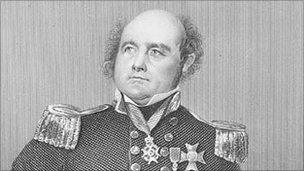
Captain Sir John Franklin had sailed the Arctic three times prior to his fateful trip
"What people have been looking for has changed. We've given up looking for survivors, we've given up looking for bodies. Now we're just looking for any answers," says William Battersby, who wrote the biography of James Fitzjames, the captain of the Erebus.
"The extraordinary thing is that despite all this effort, after 160 years and by thousands of people, we still don't know where the ships are, and what happened on the expedition, or what happened to most of the men."
Scattered remains
Explorers have found rock cairns with messages from sailors who abandoned ship. They've taken oral history from Inuit people whose ancestors saw the ships get stuck in giant ice floes. In several cases, they've dug up the bones and preserved bodies of the ship's crew. But they've found no ships, no logs, and no sign of Franklin himself.
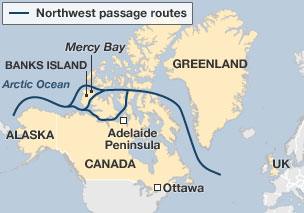
In subsequent years, a rough sketch of the troubles emerged. During the first winter, the crew disembarked, travelled south to hunt. Franklin left a reassuring message in a rock cairn, signed "All well". A month later, he was dead.
A year later, the crew returned to the cairn and updated the note. By that time, 15 sailors had died.
"If it had just been that, it would have been one of the biggest disasters of Arctic exploration," says Ted Betts, a Toronto lawyer and author of the blog Franklin's Ghost. But it wasn't just that.
From that time on, things only got worse. The men, sickened from scurvy, tuberculosis and lead poisoning, got weaker and weaker. They reportedly abandoned ship in 1848, only to meet a cold death elsewhere.
In 1859, an explorer sent by Franklin's wife travelled to the spot where the ships had been abandoned. He didn't find the Terror or the Erebus. Instead, he found a small whaleboat, full of books, chocolates, and the skeletons of two sailors.
The boat, says Russell Potter, professor of English at Rhode Island College, was pointed towards where the abandoned ship once sat.
"Maybe they weren't trying to get away, but to get back to their ship and die in comfort," he says. "It's a very poignant arrangement."
Two other locations offered a concentrated amount of remains, says Battersby. "They do seem to be associated with men who just abandoned ship, gave up hope of ever being rescued, and sadly, gradually, cannibalised the bodies of their comrades."
A few fully-preserved corpses have been found in the snow as well. But the bodies of others, including Franklin, are missing.
"They simply disappeared. It's like Apollo 13 went around the moon and never came back again," says Battersby.
"They never had a date of death, a place of death. They're immortals who are trapped between life and death. Are they ghosts? How long did the last one live? We just don't know."
Desolate and desperate
For Ron Carlson, a Chicago architect and licensed bush pilot, it's easy for him to understand why, after all these years, the ships are still missing - and how desolate the last days must have been for men on that doomed ship.
"It's vast. When I flew, I could look out over Victoria Strait and see 50 miles of ice pack in all directions," he says. "It's like the surface of the moon, but without any marks."
The broad and punishing size of the search area dwarfs the high-tech equipment and meticulous research used by the Parks Canada team, and the other explorers before them.
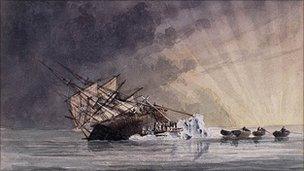
The fate of the ships inspired artwork, music and literature, including this sketch by Owen Stanley
"Both of the ships were caught in the ice for two years but slowly drifting south in a very large body of water," says Marc-Andre Bernier, chief of underwater archaeology services at Parks Canada.
That could mean that the ships are hundreds of miles apart. "For us, it's just as important to know where they're not," he says, so that future searches can start fresh.
For sailors on the Terror and Erebus, the barren landscape and dim prospects possibly only added to an increasing sense of foreboding.
"It seems very clear from several sources that the men on these ships suffered from terrible lead poisoning, which leads to depression," says Battersby, who read the records from an earlier trip by the Terror to the Arctic.
"The account of the Terror's voyage of that year says how bad the atmosphere was, how demoralised people were and how depressed they all were."
Battersby believes that the ships themselves, which had an internal pipe system to melt ice and provide fresh water, was the source of the poison.
Finding the ships could prove this theory. It would also bring to a close a search first launched in the time of Queen Victoria. But it wouldn't end the mystery.
"It's really just the beginning," says Betts. The papers, artifacts, and infrastructure will provide a whole new raft of information and leads - and more fodder for followers of the Franklin expedition's sad fate.

23_07
Culture Re-View:
Mata Hari sentenced to death for suspected espionage

By Saskia
O'Donoghue • Updated: 25/07/2023
On this day in 1917, Mata Hari was sentenced to death in Paris for
allegedly spying on Germany’s behalf during World War I. Was she really a
secret agent or just a scapegoat?
On
25 July, 1917, the exotic dancer failed to convince a military tribunal of her
alleged innocence. They took less than an hour to find her guilty and agree on
the death penalty.
Born
in 1876, Mata Hari quite possibly set the standard for people who are ‘more
than meets the eye’.
Her
name wasn’t even Mata Hari and she certainly wasn’t raised in a sacred Indian
temple and taught ancient Indian dances by a priestess as she long claimed.
In
fact, she was born Margaretha Geertruida Zelle in Leeuwarden, a small town in
the Netherlands.

The daughter of a hat shop owner, she was desperate for adventure
from her youth. At the age of 18, she answered a newspaper advert placed by
Dutch Colonial Army Captain Rudolf MacLeod who was looking for a wife. The pair
married soon afterwards.
Following
the birth of two children - one who died as a baby - and a tumultuous marriage,
Zelle moved to Paris where she eventually reinvented herself as Mata Hari.
She
was influenced by her time living with MacLeod in the Dutch East Indies - now
Indonesia - and developed a ‘Hindu’-inspired dance act.

The early days of Mata Hari
Initially
performing under the name Lady Gresha MacLeod, she would cast off a series of
colourful robes and veils until she was left nearly nude.
Her
willingness to dance almost naked saw her act go from strength to strength, as
did the adoption of her stage name Mata Hari - a Malay phrase meaning ‘eye of
the day’.
The
new moniker added to her mystique and audiences were entranced by her creative
dance moves. Her success spawned myriad imitations until she performed the
last show of her career in March 1915.

By
that year, she was known more as a courtesan, famous for her relationships with
high-ranking military officers, politicians and other influential and powerful
figures.
As
the First World War approached, Hari was mostly seen as a free-spirited
bohemian, but as the conflict grew ever closer, critics increasingly saw her as
a dangerous seductress.
By
the start of the conflict in 1914, Hari was forced to leave Berlin for her
neutral homeland of the Netherlands, where her apparent career in espionage
began.

Pat Shipman
Anthropologist
While
the details of Hari’s career as a spy remain sketchy, it is thought to have
begun in late 1915.
According
to historians, she was approached by Karl Kroemer, the honorary German consul
in Amsterdam. He considered her a valuable asset, due to her influential
contacts and ability to cross national borders freely thanks to her Dutch
citizenship.
Hari
later confirmed she had accepted the 20,000 francs offered for spying for the
Kaiser but denied taking part in any espionage. Nevertheless, she was assigned
a German codename - H21.
There
are countless reports of her allegedly spying for the Germans throughout the
conflict but it’s likely many of the accusations were unfounded.
“When
she was arrested the war was going very badly for the French and she was a
foreigner, very sexy, having affairs with everyone, and living lavishly while
people in Paris had no bread”, biographer and anthropologist Pat Shipman
has explained, adding, “There was a lot of resentment against her”.

In
the book ‘Femme Fatale: Love, Lies and the Unknown Life of Mata Hari’, Shipman
compared Hari to Marilyn Monroe in the 1960s. She was recognisable
internationally and considered to be one of the most desirable women in Europe.
“This
is part of why it is so ludicrous to think she was a spy”, said Shipman. “She
couldn't be clandestine and sneak around. She couldn't help but attract
attention”.
Hari’s
constant travelling across Europe, though, soon attracted the attention of
British intelligence, who suspected her of being an enemy agent. They had asked
their French allies to keep an eye on her too, but she became a spy for that
nation.
She
continued to dive into relationships with high-ranking military officials from
Germany and Russia, making her name synonymous with the archetypal femme
fatale.

The beginning of the end
In
December 1916, the French War Ministry accused Mata Hari of communicating the
names of six Belgian spies to the Germans.
On
13 February 1917, she was arrested and charged with espionage and confined to
Paris’ Saint-Lazare prison. Hari spent months under interrogation, always
denying any involvement in spying but speaking openly of her sexual pursuits.
“A
courtesan, I admit it,” she said. “A spy, never!”
Over
the last 106 years, historians have not been able to decide whether Mata Hari
was actually guilty of many of the charges levelled against her. While
some academics say there is enough evidence to prove she was a wide-ranging
spy, countless others suggest she was used as a scapegoat.
There
have even been reports that the sensation of her arrest, trial and death
sentence was put in place to raise morale in France during one of the darkest
periods of the war.

A rigged trial?
Mata
Hari’s espionage trial commenced on 24 July 1917. Despite huge holes in the
evidence about the secrets she might have passed to the Germans, the
prosecution blamed her for the deaths of thousands of Allied soldiers.
They
also pointed to her numerous affairs as apparent proof she had been gathering
intelligence for the enemy.
In
his closing statement, prosecutor Andre Mornet said, “the evil that this woman
has done is unbelievable”, adding: “This is perhaps the greatest woman spy of
the century”.
The
next day, the military tribunal judging Mata Hari took less than an hour to
find her guilty and sentenced her to death.
The
true extent of her espionage will likely never be known for certain and the
general consensus is that it was her independence and lifestyle choices which
led her to become a distraction for the huge losses the French army was
suffering on the Western Front.
On
15 October, 1917, she was driven to a field on the outskirts of Paris. Refusing
a blindfold, she was placed against a wooden stake and executed by a firing
squad of twelve French soldiers.
SUMMER READS - SUGGESTIONS
( best appreciated
sprawled in a fat chair accompanied with cognac and a box of beercan brownies)
August Blue by Deborah
Levy
The East Indian by Brinda Charry
Crook Manifesto by Colson Whitehead
The Postcard by Anne Berest
Victory City by Salman Rushdie
Shy by Max Porter
Shy by Max Porter
Maame by Jessica George
The Survivalists by Kashana Cauley
The Garnett Girls by Georgina
Moore

Subscribe to:
Posts (Atom)
-
 Brazil's lagoon-filled desert you can hike barefoot Lençóis Maranhenses looks like a desert, but it's alive with shimmering pools,...

