24_02


Story of the Seine: Paris exhibition explores history of the river through found objects
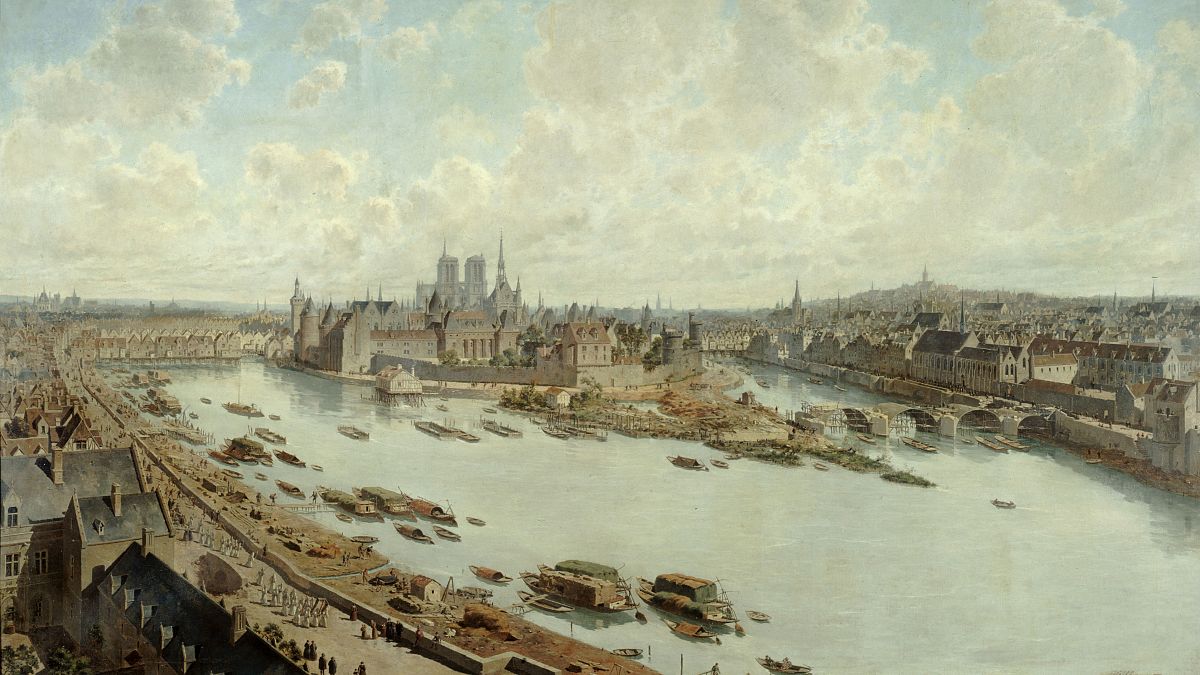
The painting "Panoramic view of Paris in 1588, from the Louvre's roof, with Pont-Neuf under construction" by Théodore-Josef-Herbert.
By Anca Ulea

Beneath the tourist-packed plaza of Notre Dame Cathedral, an archaeological site tells the story of Paris and its River Seine through objects excavated from its bed and banks. Discover the exhibition “Dans La Seine”.

With Paris preparing to host the summer Olympics this year, the Seine has found its way back into the spotlight, as city officials scramble to get it clean enough for swimming before the competition begins.

But it’s not the first time the river has attracted this kind of attention. The major artery running through the City of Lights has forever been the star of the show, the very reason the city exists at all.

A new exhibition at the archaeological crypt underneath Notre Dame Cathedral explores the importance of the Seine to the people living near it, through objects that were excavated from its riverbed and banks.

The collection of 150 trinkets tells the story of how humans have interacted with the famous river, from prehistoric times to now. In doing so, it also tells the story of how Paris became Paris.
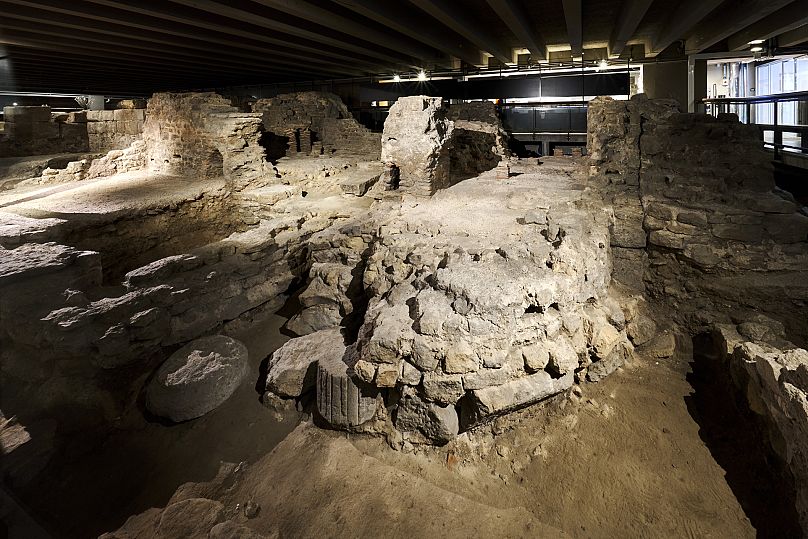
The archaeological crypt on Île de la Cité features remains from the 4th century, when Paris was a mid-sized Gallo-Roman city called Lutetia.
The archaeological crypt on Île de la Cité features remains from the 4th century, when Paris was a mid-sized Gallo-Roman city called Lutetia.Courtesy: Pierre ANTOINE/(C)P.Antoine / Musée Carnavalet

A hidden archaeological gem in the heart of Paris

If you want to visit the exhibition “Dans La Seine,” you first need to find it.

Located underneath the plaza outside Notre Dame Cathedral, the Crypte Archéologique de l'Île de la Cité (archaeological crypt of Île de la Cité) was first discovered in the 1960s during the construction of an underground car park.
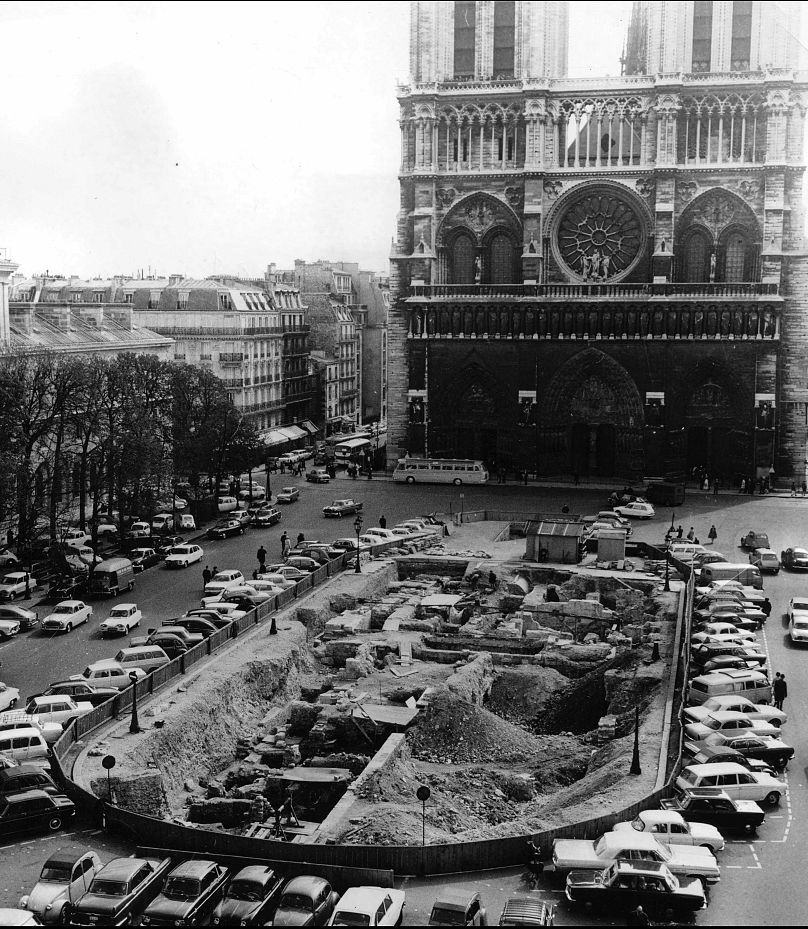
The archeological crypt of Ile de la Cité was excavated from 1965 to 1972, after its discovery during the construction of a car park.
The archeological crypt of Ile de la Cité was excavated from 1965 to 1972, after its discovery during the construction of a car park.Courtesy: Archives de Notre-Dame de Paris

Today, it’s the only archaeological site open to the public in the entire city, but even many locals have no idea it exists. The understated entrance is just a stone’s throw away from the retractable seating packed with tourists looking at the cathedral – which is still undergoing renovation work after the 2019 fire.

Once you’ve found the entrance, climb down the stairs and you’ll find a sprawling excavation site spanning 1,800 square metres and packed with extraordinarily preserved archaeological rema

The site includes vestiges of a Gallo-Roman public bath, part of an old city wall and the docking port of the Gallo-Roman city of Lutetia, which is now present-day Paris.

The space is impressive on its own, but the temporary exhibition space presents a different way of looking at the history of Paris – a story told through the items found at the bottom of the River Seine. 
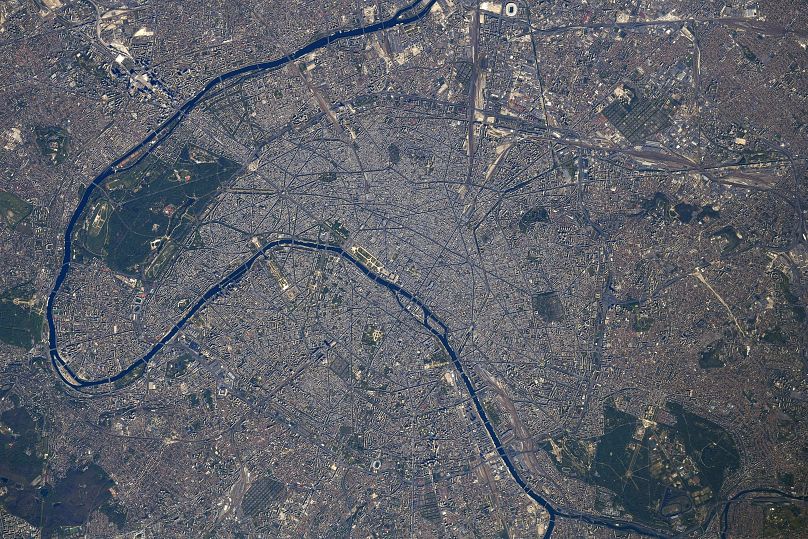
"Paris on a sunny day", 25 April 2021 by French astronaut Thomas Pesquet.
"Paris on a sunny day", 25 April 2021 by French astronaut Thomas Pesquet.Courtesy: ESA/NASA - T. Pesquet

Under the Seine

As the main waterway snaking its way across the French capital, the Seine has seen more than its fair share of human paraphernalia hit its waters. Since the dawn of time, people have been dumping things into the river – both accidentally and on purpose.

These days, you’re likely to find electric scooters and rental bikes. But back before Paris was even an abstract concept, Neanderthals left flint tools on the Seine’s banks, evidence that they weren’t as primitive as scientists once thought.

Later, when the city on the Seine was known by the name Lutetia, residents of the Gallo-Roman outpost sometimes made offerings to the river in exchange for good fortune.
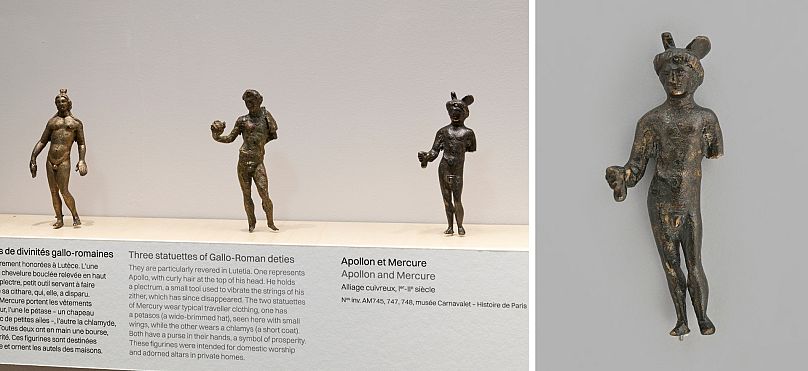
Figurines of deities Apollo and Mercury on display in the exhibition "Dans La Seine". On the right, a close-up of the figurine of Mercury.
Figurines of deities Apollo and Mercury on display in the exhibition "Dans La Seine". On the right, a close-up of the figurine of Mercury.Courtesy: Paris Musées / Musée Carnavalet - Histoire de Paris

Once adorning altars in private homes in Lutetia, metal figurines of deities like Apollo and Mercury were found underneath layers of silt on the riverbed. There are several hypotheses for how they ended up there – they could have been stolen, dropped accidentally or made as an offering.

Mysticism around the Seine was prevalent for the Gallo-Romans – also on display at the exhibition are sculptures believed to be ex-votos, or votive offerings to the deity of the Seine, Sequana. Some 1,500 of these ex-votos were found near the river's source in Burgundy, where a temple was built to Sequana.
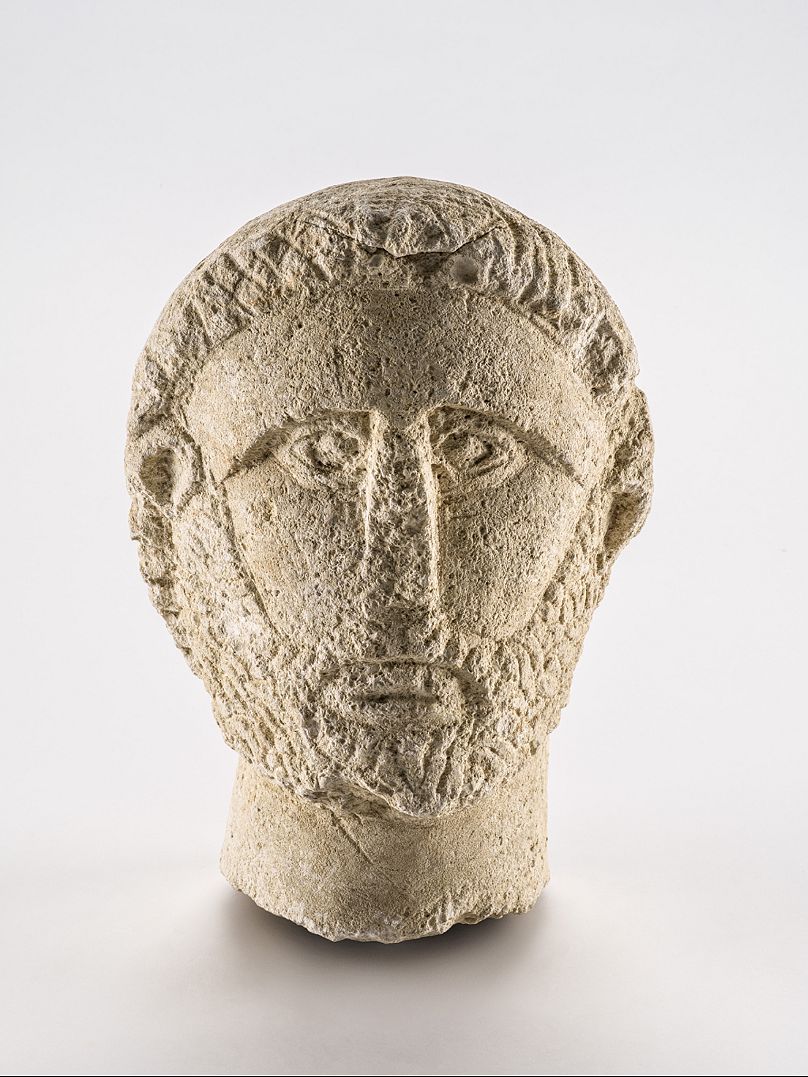
This Gallo-Roman-era limestone head is believed to be an ex-voto, or a votive offering to Seine goddess Sequana.
This Gallo-Roman-era limestone head is believed to be an ex-voto, or a votive offering to Seine goddess Sequana.Courtesy: Musée Archéologique de Dijon / Bruce AUFRERE / TiltShift

Made from stone, metal and wood, they depict animals, heads of men, women and children, full-length figures, swaddled babies and even body parts instructing the Goddess on where exactly she should apply her healing powers.

Artefacts from everyday life on the riverbanks

The cleaning and dredging of the Seine became routine maintenance for the city starting in the mid-19th century, a way of maintaining the river's depth so it would be easier to navigate. Objects were often discovered and removed when the sand and silt were extracted from the riverbed.

Objects found in the Seine from the Bronze Age and Middle Ages, after the fall of the Roman empire, include a huge collection of weapons – over 100 of them.

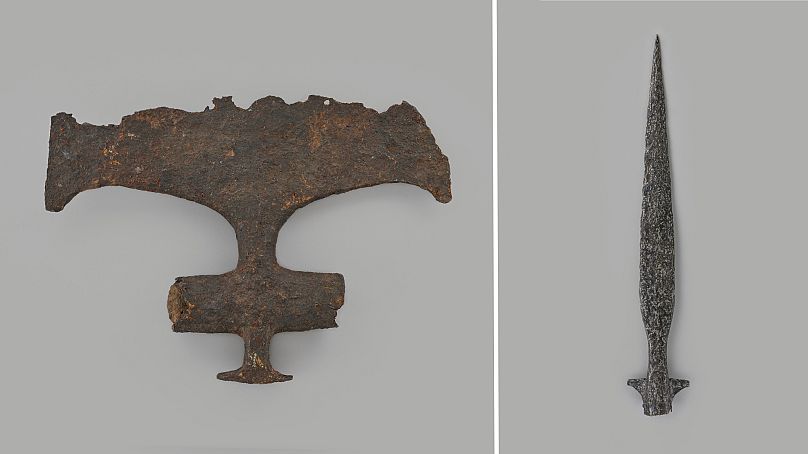
Some of these weapons – mostly battle axes and swords – are believed to have been thrown in the river on purpose, as part of a ritual at the end of battle.
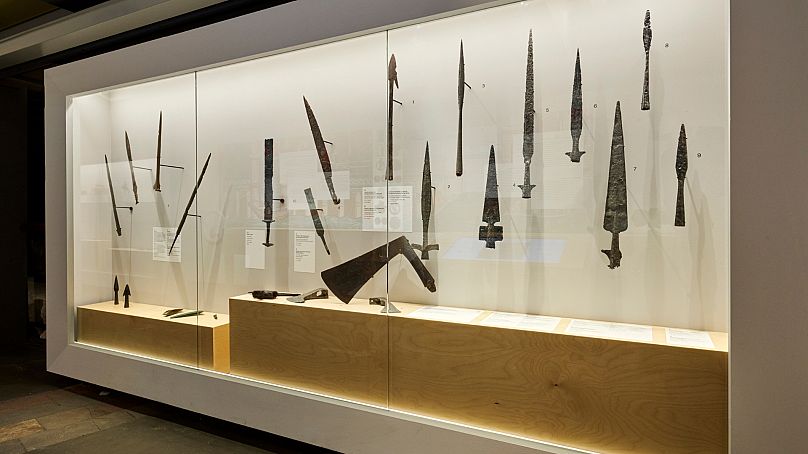
Weapons from the Bronze Age and Middle Ages on display at the exhibition "Dans La Seine".
Weapons from the Bronze Age and Middle Ages on display at the exhibition "Dans La Seine".Courtesy: Paris Musées / Musée Carnavalet - Histoire de Paris / Pierre Antoine
A battle axe (left) and spear found in the Seine.
A battle axe (left) and spear found in the Seine.Courtesy: Paris Musées / Musée Carnavalet - Histoire de Paris

Starting in the mid-19th century, small artefacts made from lead were found in their thousands in the Seine, becoming known as the “plombs de la Seine”.

They include tokens used for entries to towns and places of worship, religious figurines and even what are believed to be the first tin soldier children’s toys.
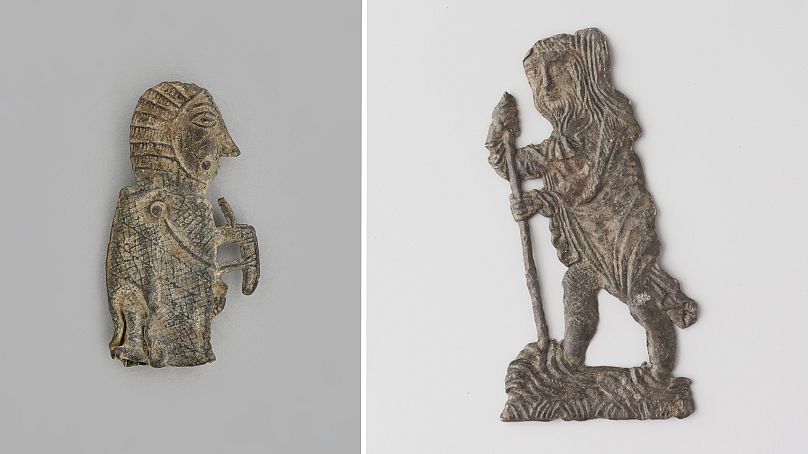
Two of the "plombs de la Seine," leaden artefacts found in the river, on display at "Dans La Seine".
Two of the "plombs de la Seine," leaden artefacts found in the river, on display at "Dans La Seine".Courtesy: Paris Musées / Musée de Carnavalet - Histoire de Paris
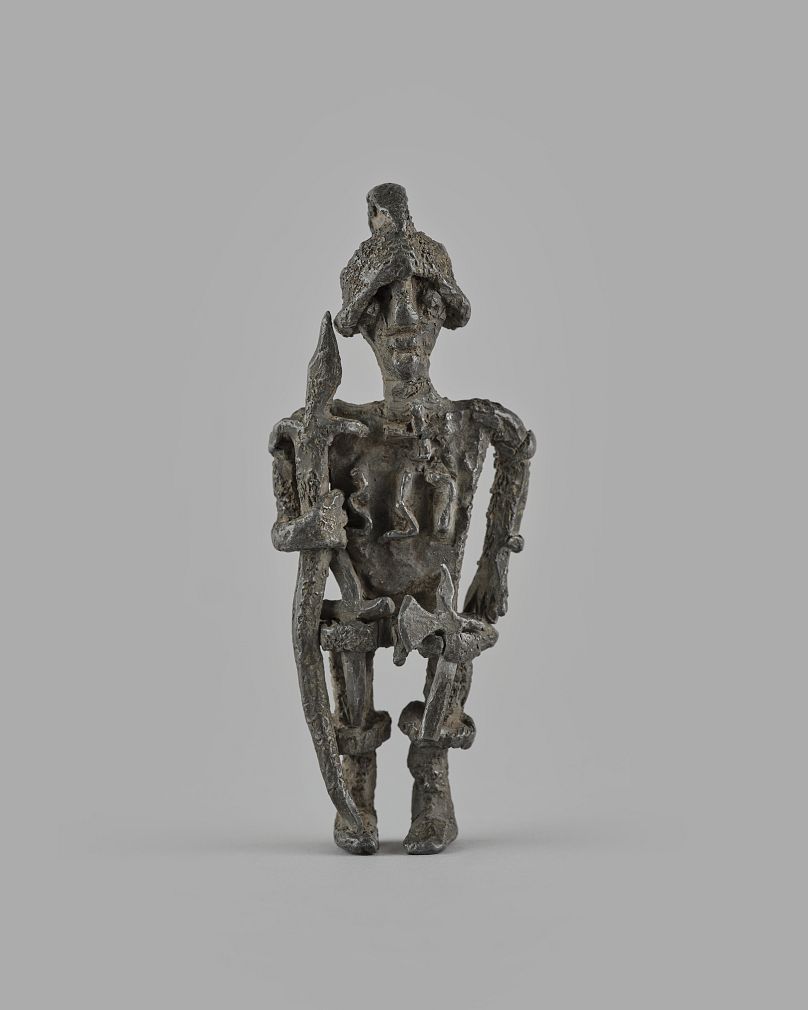
This small figurine was part of the collection of leaden artefacts discovered in the Seine. Artists Alberto Giacometti and André Breton had them in their private collections.
ver, thanks to the city's Seine River Brigade, a branch of the municipal police who are tasked with maintaining order on, around and in the river.

The brigade's divers have recovered objects including artwork, decorative elements from Paris bridges and technical equipment from ships.
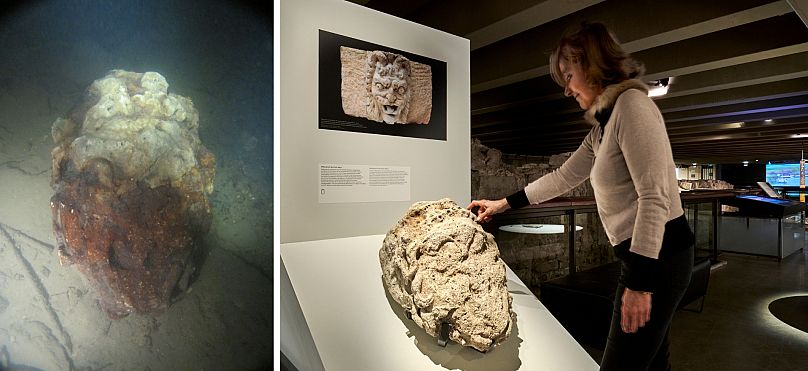
Modern discoveries by the Seine River Brigade divers include this "mascaron," stone molding in the shape of a mask.
Modern discoveries by the Seine River Brigade divers include this "mascaron," stone molding in the shape of a mask.Courtesy: Paris Musées / Brigade fluviale de Paris

In 2014, they found a sculpture at the base of Pont Neuf that was identified as a mascaron, a stone molding in the shape of a mask that can often be seen on Paris buildings and monuments.

So what about us? What will our era leave behind in the Seine for future explorers to find? 

Between the scooters, bicycles and motorbikes that have already been dredged up from the river and the debris that's sure to wash up during the Olympics, it doesn't look good.

But that's the nature of city rivers – they tell the story of the people who live around them, the good, the bad and the ugly.
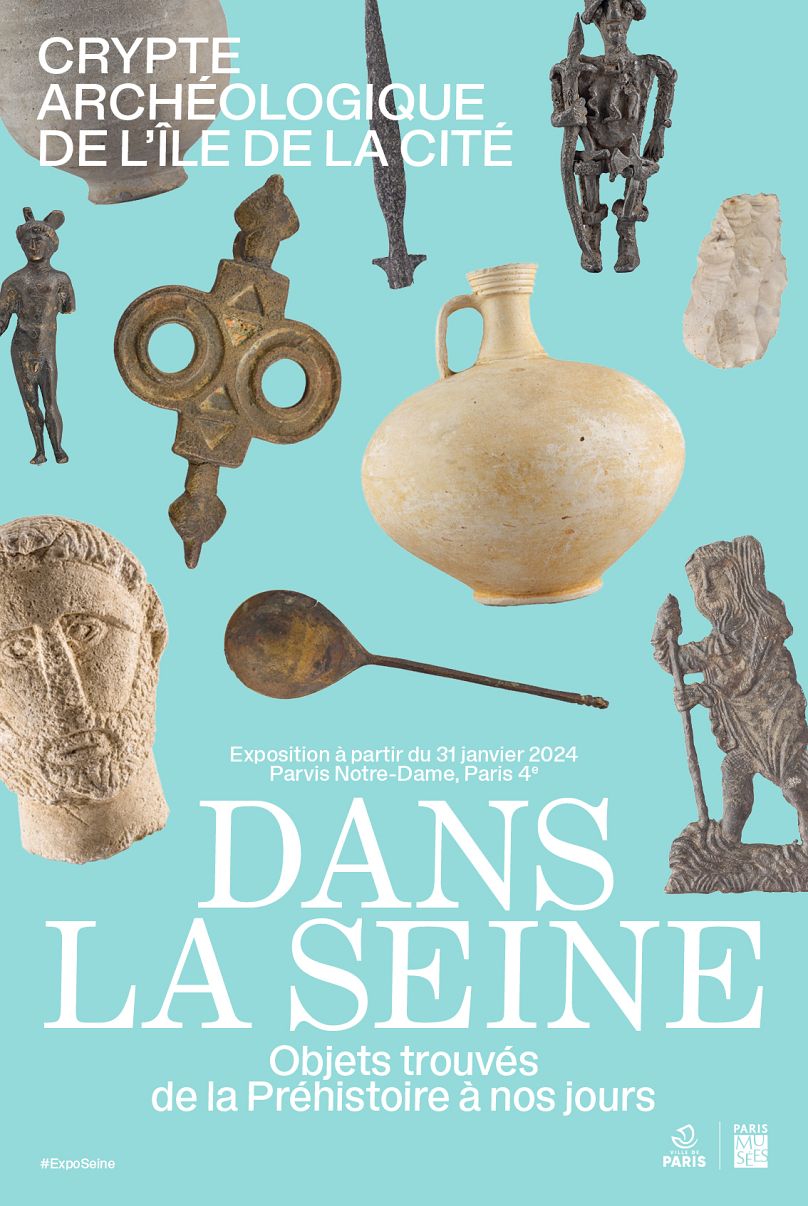
The poster for the exhibition "Dans La Seine".
The poster for the exhibition "Dans La Seine".Courtesy: Paris Musées

The exhibition "Dans La Seine" is currently open to the public at the Archaeological crypt of Île de la Cité in Paris.

 Carnaval San Felipe 2024, This weekend!!


24_01

'Earth moves away' as hot air balloons fly high above Swiss Alps


CHATEAU-D'OEX, Switzerland, Jan 25 (Reuters) - Dozens of colourful hot air balloons dotted the near-cloudless sky above the Swiss Alpine town of Château-d'Oex on Thursday during an annual festival that enthrals scores of balloon fliers and spectators from around the world.
U.S. balloon pilot Eliav Cohen, who has recorded more than 1,000 flight hours around the globe, describes the chance to fly above the Swiss Alps as "the greatest blessing I could ever ask for in my ballooning career."
"This is the most incredible place to fly in the world," he said. "To be able to fly above the Alps at 8,000-9,000 feet (2,438-2,743 m) is absolutely mind-blowing."
Seventy-five hot air balloons are taking part in the nine-day International Balloon Festival Château-d'Oex, which closes on Sunday.
Located in an Alpine valley, the town is renowned for winds that make for particularly good flying.
"Flying in a balloon, there is no turbulence," Cohen said "The Earth moves away from you, versus you moving away from it."


Huge ancient lost city found in the Amazon

Scientists found evidence of 6,000 mounds thought to be the basis for ancient homes

By Georgina Rannard

Science reporter, BBC News

A huge ancient city has been found in the Amazon, hidden for thousands of years by lush vegetation.

The discovery changes what we know about the history of people living in the Amazon.

The houses and plazas in the Upano area in eastern Ecuador were connected by an astounding network of roads and canals.

The area lies in the shadow of a volcano that created rich local soils but also may have led to the destruction of the society.

While we knew about cities in the highlands of South America, like Machu Picchu in Peru, it was believed that people only lived nomadically or in tiny settlements in the Amazon.

"This is older than any other site we know in the Amazon. We have a Eurocentric view of civilisation, but this shows we have to change our idea about what is culture and civilisation," says Prof Stephen Rostain, director of investigation at the National Centre for Scientific Research in France, who led the research.

"It changes the way we see Amazonian cultures. Most people picture small groups, probably naked, living in huts and clearing land - this shows ancient people lived in complicated urban societies," says co-author Antoine Dorison.

The city was built around 2,500 years ago, and people lived there for up to 1,000 years, according to archaeologists.

It is difficult to accurately estimate how many people lived there at any one time, but scientists say it is certainly in the 10,000s if not 100,000s.

The archaeologists combined ground excavations with a survey of a 300 sq km (116 sq mile) area using laser sensors flown on a plane that could identify remains of the city beneath the dense plants and trees.

.

This LiDAR technology found 6,000 rectangular platforms measuring about 20m (66 ft) by 10m (33 ft) and 2-3m high.

They were arranged in groups of three to six units around a plaza with a central platform.

The scientists believe many were homes, but some were for ceremonial purposes. One complex, at Kilamope, included a 140m (459 ft) by 40m (131 ft) platform.

They were built by cutting into hills and creating a platform of earth on top.

Roads, paths and canals were found connecting the platforms suggesting a large area was occupied

A network of straight roads and paths connected many of the platforms, including one that extended 25km (16 miles).

Dr Dorison said these roads were the most striking part of the research.

"The road network is very sophisticated. It extends over a vast distance, everything is connected. And there are right angles, which is very impressive," he says, explaining that it is much harder to build a straight road than one that fits in with the landscape.

He believes some had a "very powerful meaning", perhaps linked to a ceremony or belief.

The scientists also identified causeways with ditches on either side which they believe were canals that helped manage the abundant water in the region.

There were signs of threats to the cities - some ditches blocked entrances to the settlements, and may be evidence of threats from nearby people.

Researchers first found evidence of a city in the 1970s, but this is the first time a comprehensive survey has been completed, after 25 years of research.

It reveals a large, complex society that appears to be even bigger than the well-known Mayan societies in Mexico and Central America.

"Imagine that you discovered another civilisation like the Maya, but with completely different architecture, land use, ceramics," says José Iriarte, a professor of archaeology at University of Exeter, who was not involved in this research.

Some of the findings are "unique" for South America, he explains, pointing to the octagonal and rectangular platforms arranged together.

The societies were clearly well-organised and interconnected, he says, highlighting the long sunken roads between settlements.

Not a huge amount is known about the people who lived there and what their societies were like.

Pits and hearths were found in the platforms, as well as jars, stones to grind plants and burnt seeds.

The Kilamope and Upano people living there probably mostly focussed on agriculture. People ate maize and sweet potato, and probably drank "chicha", a type of sweet beer.

Prof Rostain says he was warned against this research at the start of his career because scientists believed no ancient groups had lived in the Amazon.

"But I'm very stubborn, so I did it anyway. Now I must admit I am quite happy to have made such a big discovery," he says.

The next step for the researchers is understanding what lies in an adjoining 300 sq km (116 sq mile) area not yet surveyed.  Credit BBC


 GLASS BEACH


Ussuri Bay, known as the Steklyashka beach is near Vladivostok in Russia, in the Siberian region of Primorsky. It is a glass and ceramics landfill that Mother Nature has managed to transform into a beach studded with bright gems.

Some decades ago during the Soviet era, the beach was used as a dumping ground for all kinds of bottles and scraps from a local porcelain factory. Its waters were the most polluted in the area and the beach was impractical and dangerous, so local authorities imposed a access ban on it.


Over the years, the incessant action of the sea has eroded and shaped pieces of glass and porcelain making beautiful smooth and shiny pebbles, giving the bay a new and wonderful appearance. Yet another magic of mother nature, capable of remedying human error.


Today, the beach is a protected area and is accessible to tourists. It is a magnificent stretch of land, illuminated by thousands of colored lights, surrounded by towering cliffs that overlook a crystal-clear sea.


Similar glass beaches are located in Fort Bragg, California and Benicia (California), and also in Guantanamoand in Hanapepe,Hawaii.


23_12


OUR OFFICES WILL BE CLOSED ON DECEMBER 25 AND 26, AND JANUARY 1 AND 2.


HAPPY HOLIDAYS!!