Where to get New York City's best Chinese food
 Ernesto Roman
Proud New Yorker chef Calvin Eng is known for his daring reinterpretations of Chinese cuisine. Here's where he goes when he wants homestyle Chinese food, from dim sum to egg tarts.
Though its original Chinatown in Lower Manhattan – dating to the 1870s – is the most well-known, New York City is actually home to nine official Chinatowns spread across its five boroughs; each reflecting the rich regional diversity of Chinese cuisine.
The city's first Chinatown took root when Chinese immigrants, many from southern China, arrived either directly or relocated from the US's West Coast, fleeing anti-Chinese sentiment. Early businesses were mostly rice shops and teahouses, but by the early 1900s, full-service restaurants emerged, drawing curious diners from all over New York. By the mid-20th Century, Chinese food, in all its glorious forms, had become as associated with New York City as the humble bagel or the New York slice.

The SpeciaList
Brooklyn-born Calvin Eng is the chef and owner of Bonnie's, which has been praised in the New York Times, The New Yorker, Grub Street, Eater and Bon Appétit. Eng is a James Beard Emerging Chef finalist, a Food & Wine Best New Chef, a Forbes 30 under 30 recipient, a StarChefs Rising Star and a two-time James Beard Best Chef: New York State Semifinalist. His cookbook, Salt Sugar MSG, was published on 18 March 2025.
Among the new generation carrying this legacy forward is chef Calvin Eng, the owner of Bonnie's; a Cantonese American restaurant in Williamsburg, Brooklyn, that has been lauded for its inventive interpretations of Cantonese cuisine. Eng grew up in Bay Ridge, Brooklyn, learning to cook the food of Guangdong (formerly known as Canton) from his mother, the eponymous Bonnie. Weekends were spent visiting his grandparents on Bayard Street in New York City's Lower Manhattan Chinatown, where he developed a deep connection to the neighbourhood and its food.
"There's just so much good food in such a small area," Eng says. "You learn what's worth lining up for and what's best eaten on a subway platform." These days, Eng gets his Cantonese fix at a variety of New York's Chinatowns, from Sunset Park to Bensonhurst, each offering its own take on Chinese flavours – from the seafood-heavy dishes of Guangdong to the bold, spicy flavours of Sichuan and Hunan.
Despite the breadth of regional styles found across the city, Eng's focus remains rooted in the cuisine of southern China. Unlike other styles, Cantonese food is known for its lightness and simplicity, emphasising fresh ingredients, particularly seafood – a reflection of the region's coastal geography. Heavy spices are rare, and rice – not wheat – is the dominant starch.
"Cantonese food is very low on acid and heat," Eng explains. "We use minimal ingredients that allow the main ingredients to shine."
Here are Eng's favourite places to get Chinese food in New York City.
 Ernesto Roman
1. Best cheung fun: Yi Ji Shi Mo (Lower Manhattan)
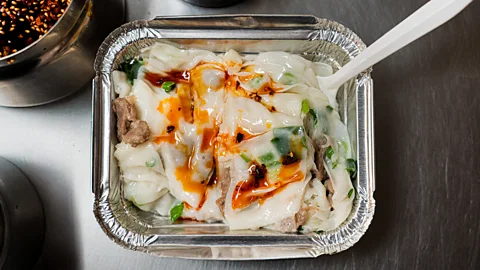
Insiders know that in Chinatowns across the world, some of the most unassuming places have the best food. Yi Ji Shi Mo – a tiny, below-street-level hole-in-the-wall on Lower Manhattan's Elizabeth Street – is no exception. Here, the specialty is made-to-order cheung fun; Cantonese-style steamed rice rolls filled with shrimp, beef, pork and other savoury ingredients.
Cheung fun can be found all over New York City's Chinatowns, but Eng says what makes the offerings at Yi Ji Shi Mo stand out is their rice wrapper: it's perfectly thin with a satisfying chew and bounce. "They mill the rice into flour fresh every morning to make the batter," he explains. "Then they steam it, fill it, roll it up, pop it in a takeout box, give you a packet of their seasoned soy sauce, and you're on your way."
Eng eats cheung fun for breakfast, lunch or just a snack whenever he's in the area. The wait can be a bit long since everything is made fresh, but he says it's worth it – or you can try calling ahead. "My go-to is always the large – which isn't even that large – with beef, scallion and cilantro," he says. "And I just douse it in their soy sauce."
Address: 88 Elizabeth Street, New York, NY 10013
Phone: +1 646-233-6311
 Ernesto Roman
2. Best for Xinjian skewers: Grand Street Skewer Cart (Lower Manhattan)
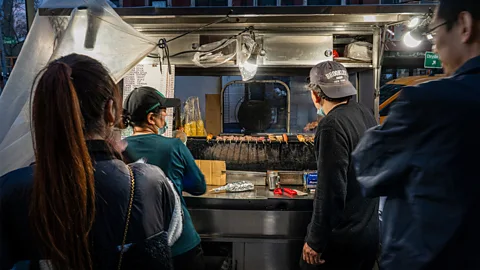
A little slice of Xinjian, an autonomous region in north-western China, can be found at the iconic Grand Street Skewer Cart on Lower Manhattan's Grand Street.
The vendors are a husband-and-wife duo who prepare Xinjian-style meat skewers (yang rou chuan) straight out of a cooler; you can smell the sizzling aroma of roasted lamb and spicy cumin from over a block away, says Eng. "I don't know what their schedule is, but when they're there, it's a treat, like a special surprise," he says. "If it's raining, snowing or even just a little cold, they're probably not going to be there. But when the weather's nice, you have to take the chance and go."
The cart is set up just outside a busy train station, and like many commuters, Eng buys a bunch of the inexpensive skewers to eat on the subway ride home to Brooklyn. The selection is impressive: lamb, beef, chicken, fish balls, mushrooms, onions, leeks – even aubergine. "Whether you get it spicy or not is up to you," Eng says, "but the spicy skewers are very, very tasty."
"The cart is really special and unique – you don't find anything like it in Chinatown," he adds. "Restaurants aren't doing this kind of thing because it's live fire and not easy to pull off. Getting to experience that on the street is very cool."
Address: Corner of Grand St and Chrystie Street, New York, NY 10002
 Ernesto Roman
3. Best Chinese banquet: Hop Lee Restaurant (Lower Manhattan)
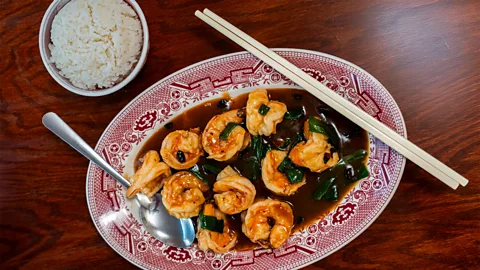
The Chinese banquet experience is a joyful multi-course feast typically shared at big, round tables to celebrate birthdays, weddings or even just a fun night out with friends. Eng's go-to for a classic banquet is Hop Lee on Mott Street; a beloved Chinatown institution since 1973, with all the essentials: oversized tables, lazy Susans and a vast menu.
"They have the old-school stuff you can't get all in one place anymore," Eng says. Highlights include razor clams in black bean sauce, honey walnut shrimp and a wide variety of chicken dishes: half, whole, poached, fried. But one dish in particular stands out to Eng: the eternally popular Cantonese lobster with pork.
"It starts with the Chinese trinity of ginger, garlic and scallions," Eng explains. The lobster is broken down Chinese-style, which means it's chopped into 14 easy-to-eat pieces, so there's no need for cracking shells. "The flavours of the trinity really come through in the wok," he says, "and they stir-fry it with ground pork, which adds this whole extra layer of depth that most lobster dishes just don't have. It's delicious."
Website: www.hopleenyc.com/
Address: 16 Mott Street, New York, NY 10013
Phone: +1 212-962-6475
Instagram: @hop_lee_nyc/
 Ernesto Roman
4. Best roasted meats: King's Kitchen (Manhattan, Brooklyn)
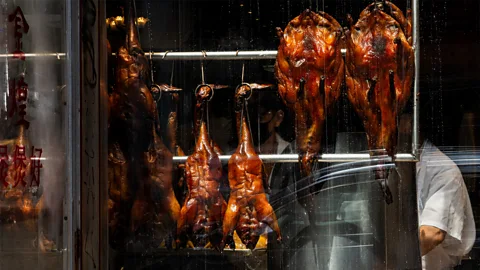
Throughout the winding streets of Manhattan's Chinatown, roast ducks, chickens and slabs of pork hang in steamy restaurant windows. For Eng, King's Kitchen stands out for serving the best of these iconic barbecued meats. With multiple locations across Manhattan and Brooklyn, the purveyor offers a vast menu, including dim sum, but it's the roasted meats that keep Eng coming back.
Insider tip:
When ordering char siu, Eng says you can request your preferred cuts. "You can order lean, you can order fat or you can order half and half," says Eng, who orders his half fatty, half lean. "The guy at the counter will know which cuts to pull and chop for your order. If you don't specify, they just give you whatever." But, he adds, "I think it's a very different eating experience to get what you prefer. I love the half-and-half bites."
"The char siu (roast pork) is perfectly balanced – sweet and salty, charred and glistening because it's always fresh," he says. The marinade, a blend that includes bean paste and Chinese five-spice, is rubbed inside the cavity of the pig, giving the meat deep, rich flavour all the way through.
"King's Kitchen does steady business, so they're popping out fresh things all the time," Eng adds. "This way you know the meat is not just sitting there all day."
Website: kingskitchenusa.com/
Address: 92 East Broadway, New York, NY 10002
Phone: +1 212-966-7288
Instagram: @jinhuanggroup/
 Getty Images
5. Best seafood: BK Seafood Market (Sunset Park, Brooklyn)
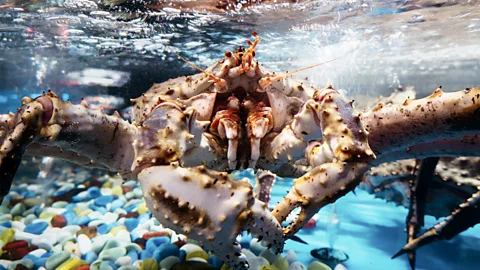
When he's in the mood for seafood, Eng heads to Brooklyn's Sunset Park neighbourhood to hit BK Seafood Market – a large restaurant with rows of bubbling tanks filled with live fish, crustaceans and molluscs. Diners can pick exactly what they want and have it cooked to order, just minutes from tank to table.
"It's a rare opportunity to eat something that was literally swimming two minutes before it was cooked," says Eng. One of his favourite orders is king crab prepared three ways, a "massive feast of king crab", he says.
He also chooses a fresh whole fish and asks for it steamed with soy sauce, ginger and spring onions. "When the seafood is this fresh, you don't want to ruin it," he says. "Steaming keeps it clean and simple and that's how you taste how good it really is."
Website: www.bkseafoodmarketnyc.com/
Address: 842 64th St, Brooklyn, NY 11220
Phone: +1 718-836-6888
Instagram: @bkseafoodmarket1/
 Getty Images
6. Best dim sum: Park Asia (Sunset Park, Brooklyn)
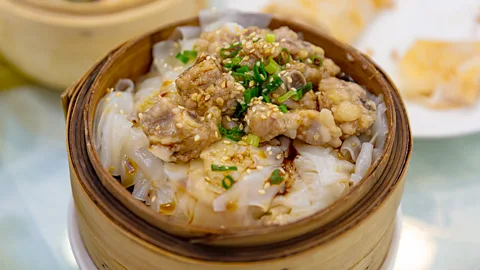
"If I want the full dim sum experience, I go for a big location – a place with, like, 1,000 seats," says Eng. For that, he heads to Park Asia; a sprawling two-storey space with high ceilings and a bright, bustling vibe. "It's where I had my son's 100-day party [a celebration marking a child's first 100 days in Chinese culture] with 100 people," he says.
For Eng, the ideal dim sum restaurant offers the most variety. "When I get dim sum from a cart, I want a lot of different things on the table," he says. And the key to a good spot? "It should be packed. That means the food's fresh, and nothing's been sitting on the cart for more than half an hour."
The selection is huge, from pork siu mai and shrimp dumplings to specials that rotate with the seasons. In the evenings, Park Asia shifts into banquet-style dining, but the dim sum crowd is always out in full force – even on a Monday morning.
Website: park-asia.restaurants-world.com/
Address: 6521 8th Ave, Brooklyn, NY 11220
Phone: +1 718-833-1688
Instagram: @parkasiarestaurant/
 Getty Images
7. Best Hong Kong-style egg tarts: Xin Fa Bakery (Sunset Park, Brooklyn)
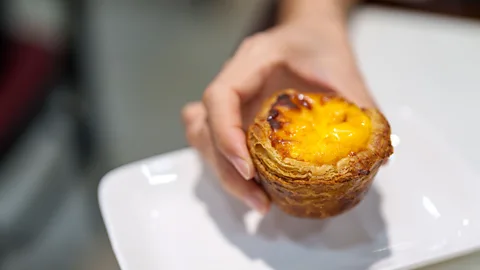
For the best egg tarts in the city, Eng makes a beeline to Xin Fa Bakery. But he doesn't just buy one. "You get a dozen," he says. "They're always hot and always fresh."
These are the classic Hong Kong-style dan tat – small, flaky tarts filled with silky egg custard. For Eng, the perfect one has a wobble. "When you bite into it, it should be jiggly and almost fall out of the crust," he explains. "You don't want it to be fully set. And you definitely don't want to see your teeth marks in it."


