23_05

 Renascence man & Public Enemy No. 1 in U.S  and Mexico


the most fascinating and prolific Mexican inventor was Victor Ochoa. A multifaceted character, Ochoa was by turns an inventor, revolutionary, journalist, union organizer, miner, business owner and a fugitive from the law in both Mexico and the United States.

Ochoa was born in Ojinaga, Chihuahua in Mexico but was raised in El Paso, Texas. In 1889 he obtained U.S. citizenship and began a life of political and social activism. In 1891, he held a meeting where he delivered a speech about the need for self-protection and fair wages to a group of 300 Mexicans living in El Paso. At the same time, he helped organize La Unión Occidental Mexicana to preserve Spanish as a language and promote cooperation and support among the Mexican community.

When he discovered that Mexican President Porfirio Díaz had ordered the confiscation of land owned by his family in Chihuahua, Ochoa became a revolutionary. Believing the Porfirio Díaz regime to be a monarchy, Ochoa decided that Díaz needed to be overthrown.

Ochoa organized his own army of several hundred Mexicans living in El Paso and led what may have been the earliest uprising against Díaz. He and his men would go back and forth between El Paso and Chihuahua, attacking federal soldiers. On one of their raids, he and his rebels were ambushed by Díaz’s army, who killed most of his men and arrested Ochoa.


Victor Ochoa photographed in the late 19th century, when he was not only coming up with inventions but also leading rebel activity against Mexico’s dictator Porfirio Díaz. (Smithsonian)

Historians believe that he escaped by stealing a military uniform. Ironically, however, Diaz’s soldiers mistook him for a deserter and chased him for 300 treacherous miles through the mountains until he finally eluded them.

Díaz offered a $50,000 peso reward for Ochoa’s capture, dead or alive. Evading bounty hunters, Ochoa took refuge in Fort Stockton, Texas, but was eventually arrested by American authorities for violating U.S. neutrality laws. He got himself acquitted and returned to the border to resume his insurgent activities.

Although he was continuously on the run, evading arrest on both sides of the Rio Grande, Ochoa declared to the U.S. press that he would continue his efforts to overthrow Díaz and fight for the rights of the Mexican people.

Ochoa was arrested once again in 1895 by the Texas Rangers for violating federal neutrality laws. He was sentenced to 2½ years in the Kings County Penitentiary in Brooklyn, New York, and lost his U.S. citizenship. 

Díaz insisted he be extradited to Mexico, but President Grover Cleveland refused. During his incarceration, Ochoa began his career as an inventor, sketching his ideas on pieces of paper.

After his release, Ochoa spread rumors of his own death to throw off bounty hunters and settled down with his family in New Jersey to begin transforming his sketches into actual inventions. 

Among them were an adjustable wrench which he called “clincher plyers”; the reversible motor; a magnetic brake for streetcars, which he sold to the American Brake Company; a fountain pen design, which he sold to the Waterman Company; and a pen design featuring a pocket clip that he sold to the American Pen and Pencil Company. The windmill he designed created enough electricity to light a house. 

But the star of his inventions was one of the earliest aircraft prototypes, what he called a collapsible monoplane, or the Ochoa Plane — a glider with folding wings that he mounted on two bicycle frames. To develop his inventions, Ochoa founded the International Airship Company and the Ochoa Tool & Machine Company. 

On February 15, 1906, years after his release from prison, his friend U.S. President Theodore Roosevelt granted his application for a pardon and restored his American citizenship. Ochoa continued to monitor political developments in Mexico from New Jersey. One day, however, he suddenly disappeared, leaving behind his inventions. 


He had returned to El Paso to continue his political activities, combining them with journalism; he founded two newspapers, El Hispano-Americano and El Correo del Bravo. Documents from the archives at the National Museum of American History at the Smithsonian show that Ochoa was incarcerated again at the United States Penitentiary in Leavenworth, Kansas, on February 18, 1917, and released on May 1, 1918. 

While in Leavenworth, Ochoa continued to market his inventions, even writing the Navy to suggest that they use his Ornithopter as a prototype for designing airplanes.

Ochoa was also a miner, acquiring two gold mines in Sonora. He went into a business partnership on the mines with two men who offered to help him enlarge his gold mine production. They later double-crossed him, stealing all his gold and horses and leaving him to die in the desert. 

According to interviews given by his son Stephen Ochoa, in 1936, his father was walking down the street in El Paso with the police chief when he saw his two former business partners coming toward him; they drew their guns. Ochoa was unarmed but grabbed the chief’s gun and killed them both. 
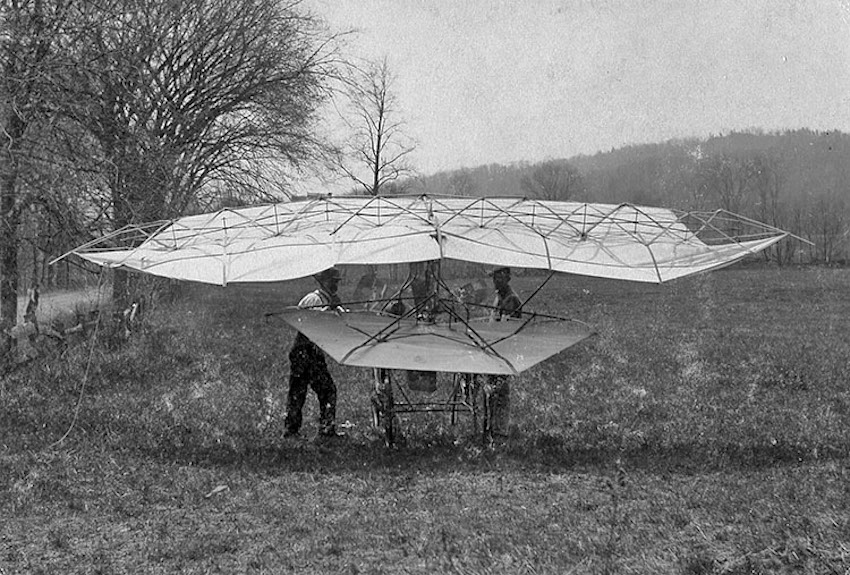
Two men holding a prototype aircraft with a bicycle frame, another of Ochoa’s inventions. (Smithsonian)

Ochoa was once again brought before a judge, who determined that the shootings were justified but told Ochoa that given that the two dead men were from influential families, it might be best if Ochoa returned to Mexico. Ochoa took the judge’s advice and moved to Sonora in 1936.

Between 1901 and 1922, Ochoa was a prodigious inventor, even while leading an uprising, evading the law and being incarcerated. In addition to his patents in the United States and Mexico, he received patents in nine other countries.

This remarkable man is believed to have died in 1945 in Sonora with his wife Amanda Cole — granddaughter of painter Thomas Cole, founder of the Hudson River School for artists — at his side.

Sheryl Losser is a former public relations executive and professional researcher. She spent 45 years in national politics in the United States. She moved to Mazatlán in 2021 and works part-time doing freelance research and writing.


 

        Astronomers discover largest ever cosmic explosion


 Astronomers discover largest ever cosmic explosion

The fireball is still burning with the brightness of two trillion suns


An artist's impression of a black hole swallowing a gas cloud ©  University of Southampton

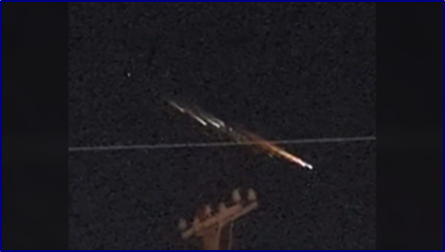
A team of astronomers have identified what they believe to be the largest cosmic explosion ever witnessed. Located billions of light years away in outer space, the blast is 100 times the size of our solar system and has grown in intensity over three years.

The blast initially went unnoticed by human observers, but was picked up in 2020 by the Zwicky Transient Facility in California, which monitors the night sky for sudden increases in brightness. Researchers pored over data from the facility the following year, before a team of researchers led by astrophysicist Philip Wiseman at Britain’s University of Southampton tracked it with their telescopes.

When Wiseman’s team discovered just how far away the explosion was, its full scale became apparent.

The blast – known as AT2021lwx – is located 8 billion light years away from Earth, meaning it must have taken place when the universe was only 6 billion years old. “We’ve estimated it’s a fireball 100 times the size of the solar system with a brightness about two trillion times the sun’s,” Wiseman told The Guardian on Friday. “In three years, this event has released about 100 times as much energy as the sun will in its 10 billion-year lifetime.”


AT2021lwx is not the brightest cosmic event ever recorded. That title is held by a gamma-ray burst known as GRB 221009A, which was recorded by a NASA satellite observatory last year.

However, GRB 221009A lasted for ten hours, while AT2021lwx has been burning for three years, and is still increasing in brightness, all at three times the distance from Earth as GRB 221009A.

Wiseman’s team deduced that the explosion is too big to have been caused by an exploding star, or supernova. The next most likely scenario, they wrote in the Monthly Journal of the Royal Astronomical Society, was a ‘tidal disruption event’, in which a star is pulled apart by a giant black hole.

However, if AT2021lwx were caused by such an event, it would have required a star up to 15 times the mass of our sun. Given the rarity of such stars, the researchers have theorized that the explosion was triggered by a supermassive black hole consuming an enormous cloud of gas around 5,000 times larger than the Sun.

Wiseman told France’s AFP news agency that while the theory is “fully plausible,” the origin of the explosion remains “an absolute puzzle.”


‘Terrible maritime chapter’ closes as Fugro locates 80-year-old WW2 shipwreck

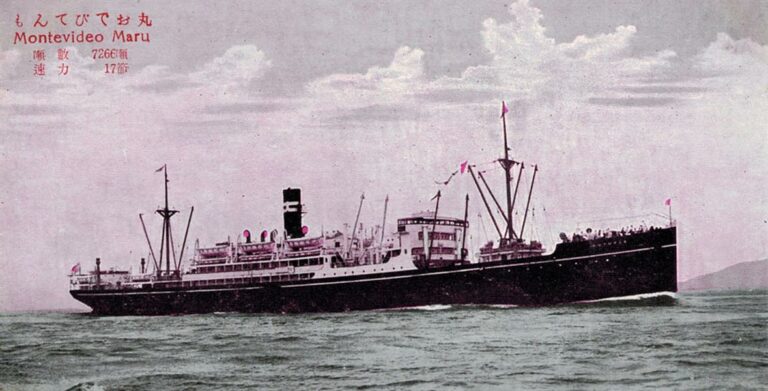
Fugro has taken part in a mission to locate the wreck of a World War II ship 81 years after sinking, reported as one of the worst international maritime disasters in history.

Image courtesy of Silentworld Foundation

Fugro started the search for the Montevideo Maru transport ship on 6 April onboard the hydrographic survey vessel Fugro Equator.

Deploying an autonomous underwater vehicle (AUV) with an in-built sonar, a positive sighting of the Japanese ship was recorded 12 days later at a depth of more than 4,000 meters off the coast of the Philippines.

Verification of the wreck came a few days later from the project team, which comprised maritime archaeologists, conservators, operations and research specialists, and ex-naval officers.

The Montevideo Maru was carrying approximately 1,060 war prisoners and civilians when it was sunk by an American submarine in 1942 during World War II.

The tragedy resulted in fatalities from at least 14 countries, including Australia, Denmark, England, Estonia, Finland, the Netherlands, Japan, Ireland, New Zealand, Norway, Scotland, the Solomon Islands, Sweden and the U.S.

Mark Heine, CEO of Fugro, said: “This maritime tragedy involved many countries and families, and all paid a terrible price. I’m proud that our skills and technology can help find resolutions to historical projects such as this and, in this way, make a real difference to people’s lives.“

Fugro worked in partnership with the Silentworld Foundation and the Rabaul and Montevideo Maru Society, with support from Australia’s Department of Defence, to carry out the mission said to have taken nearly five years of planning.

“The discovery of the Montevideo Maru closes a terrible chapter in international military and maritime history,” said John Mullen, Director of the Silentworld Foundation.

“Today, by finding the vessel, we hope to bring closure to the many families devastated by this terrible disaster. I would like to express my gratitude to all of the dedicated Silentworld team involved in this expedition, to the outstanding Fugro crew and technical team onboard the Fugro Equator, and to the Australian Department of Defence for their unwavering support.”

23_04


In Nagoro, scarecrows outnumber human residents.

As an isolated valley town in the less-trodden Japanese island of Shikoku, Nagoro is difficult to reach – buses are infrequent and the nearest train station is an hour away – but it hasn’t deterred the 3,000 or so people per year who visit, a few of whom return annually.

Times have definitely changed for Nagoro, similar to the plight of other Japanese villages with aging populations.

In Ayano’s childhood years, there were more than 300 residents, including families with young children.

Today, there are 27 residents; the youngest is over the age of 50. Ever since Ayano’s return to Nagoro in 2002, many of the older residents, including her next-door neighbors, have passed away, while the younger ones moved to Japan’s larger towns and cities en masse for better economic opportunities.

Ayano came up with the idea of creating effigies of former residents as a way of memorializing them while infusing some spirit into the vanishing village.

Soon after making the first few scarecrows for practical farmland purposes in 2003, she created one in the likeness of a late neighbor she used to talk with every day, so that she could “speak” to her like old times.

As more villagers passed away or relocated, she began creating more neighbor-esque scarecrows (a three-day process per doll) in remembrance of their presence.

“Before the scarecrows, it was just an ordinary village no one really cared about,” Ayano says.

That remained mostly true even after the scarecrow displays arrived, until a visiting German filmmaker, Fritz Schumann, did a short documentary in 2014 on Ayano’s work, titled “Valley of Dolls,” attracting global attention and intrigue to an unassuming hamlet in the Tokushima prefecture.

Scarecrow workshops

During a visit, one can see scores of scarecrows going about their daily lives outdoors: construction workers with hard hats “installing” a road sign; an affectionate couple sat on tree stumps watching the gurgling river; a wellington boot-wearing fisherman taking a break on his front porch with his young daughter alongside him; and several coat and hat-clad adults assuming different gardening roles that look uncomfortably real.

The village’s only school was shut down a few years ago as the last two elementary students graduated.

What would have been an abandoned building is now an unofficial “museum” of students, teachers, parents and imaginary figures. There’s a classroom of 12 or so attentive, wide-eyed pupils at their desks as the teacher delivers a lesson.


On the surface, Nagoro is like any other sleepy riverside village in southern Japan’s remote Iya Valley.

A winding drive through the small town appears to reveal elderly residents tending to their gardens and families waiting patiently at a bus stop. It all seems normal… until you realize that most of those “people” aren’t people.

They’re life-sized scarecrows – and they outnumber the human residents ten-to-one.

The cotton-stuffed oddities are the brainchild of Tsukimi Ayano, a crafts hobbyist who returned to the village in 2002 after living in Osaka for most of her life.

“I never expected people from all over the world to come to this small village,” says Ayano, speaking to CNN Travel from inside her classroom-like scarecrow workshop space.


Al Jaffee, Trailblazing ‘Mad’ Magazine Cartoonist, Dies at 102


 ANOTHER CREATIVE MIND FADES

INTO OBLIVION

IRREPLACEABLE

Al Jaffee seeks the other side, so I suggest that “either-land” is in for a bumpy ride, but a  joyous ride as he creates another mad, mad world on the other side. A true genius.

 Up-close laboratory pictures of ancient mummy as scientists recreate his life and times