23_07


Culture Re-View: Mata Hari sentenced to death for suspected espionage


By Saskia O'Donoghue 25/07/2023

On this day in 1917, Mata Hari was sentenced to death in Paris for allegedly spying on Germany’s behalf during World War I. Was she really a secret agent or just a scapegoat?

On 25 July, 1917, the exotic dancer failed to convince a military tribunal of her alleged innocence. They took less than an hour to find her guilty and agree on the death penalty.

Born in 1876, Mata Hari quite possibly set the standard for people who are ‘more than meets the eye’.

Her name wasn’t even Mata Hari and she certainly wasn’t raised in a sacred Indian temple and taught ancient Indian dances by a priestess as she long claimed.

In fact, she was born Margaretha Geertruida Zelle in Leeuwarden, a small town in the Netherlands.


Mata Hari in 'La Scala', 1911Heritage Images/Fine Art Images/Getty

The daughter of a hat shop owner, she was desperate for adventure from her youth. At the age of 18, she answered a newspaper advert placed by Dutch Colonial Army Captain Rudolf MacLeod who was looking for a wife. The pair married soon afterwards.

Following the birth of two children - one who died as a baby - and a tumultuous marriage, Zelle moved to Paris where she eventually reinvented herself as Mata Hari.

She was influenced by her time living with MacLeod in the Dutch East Indies - now Indonesia - and developed a ‘Hindu’-inspired dance act.

                                                                Mata Hari in a dance outfit c.1906AP

The early days of Mata Hari

Initially performing under the name Lady Gresha MacLeod, she would cast off a series of colourful robes and veils until she was left nearly nude.

Her willingness to dance almost naked saw her act go from strength to strength, as did the adoption of her stage name Mata Hari - a Malay phrase meaning ‘eye of the day’.

The new moniker added to her mystique and audiences were entranced by her creative dance moves. Her success spawned myriad imitations until she performed the last show of her career in March 1915.


A depiction of Mata Hari as Salome (date unknown)Heritage Images/Fine Art Images/Getty

By that year, she was known more as a courtesan, famous for her relationships with high-ranking military officers, politicians and other influential and powerful figures.

As the First World War approached, Hari was mostly seen as a free-spirited bohemian, but as the conflict grew ever closer, critics increasingly saw her as a dangerous seductress.

By the start of the conflict in 1914, Hari was forced to leave Berlin for her neutral homeland of the Netherlands, where her apparent career in espionage began.


Identification documents of Margaretha Zelle, also known as Mata Hari, on display at the Fries Museum in Leeuwarden, Netherlands, 2017The AP

'The evidence is quite strong that she was completely innocent of espionage'

Pat Shipman

Anthropologist

While the details of Hari’s career as a spy remain sketchy, it is thought to have begun in late 1915.

According to historians, she was approached by Karl Kroemer, the honorary German consul in Amsterdam. He considered her a valuable asset, due to her influential contacts and ability to cross national borders freely thanks to her Dutch citizenship.

Hari later confirmed she had accepted the 20,000 francs offered for spying for the Kaiser but denied taking part in any espionage. Nevertheless, she was assigned a German codename - H21.

There are countless reports of her allegedly spying for the Germans throughout the conflict but it’s likely many of the accusations were unfounded.

“When she was arrested the war was going very badly for the French and she was a foreigner, very sexy, having affairs with everyone, and living lavishly while people in Paris had no bread”, biographer and anthropologist Pat Shipman has explained, adding, “There was a lot of resentment against her”.


The official death sentence document for Mata Hari, 1917Heritage Images/Fine Art Images/Getty

In the book ‘Femme Fatale: Love, Lies and the Unknown Life of Mata Hari’, Shipman compared Hari to Marilyn Monroe in the 1960s. She was recognisable internationally and considered to be one of the most desirable women in Europe.

“This is part of why it is so ludicrous to think she was a spy”, said Shipman. “She couldn't be clandestine and sneak around. She couldn't help but attract attention”.

Hari’s constant travelling across Europe, though, soon attracted the attention of British intelligence, who suspected her of being an enemy agent. They had asked their French allies to keep an eye on her too, but she became a spy for that nation.

She continued to dive into relationships with high-ranking military officials from Germany and Russia, making her name synonymous with the archetypal femme fatale.


Mata Hari pictured in her finery in the early 20th CenturyHeritage Images/Fine Art Images/Getty

The beginning of the end

In December 1916, the French War Ministry accused Mata Hari of communicating the names of six Belgian spies to the Germans.

On 13 February 1917, she was arrested and charged with espionage and confined to Paris’ Saint-Lazare prison. Hari spent months under interrogation, always denying any involvement in spying but speaking openly of her sexual pursuits.

“A courtesan, I admit it,” she said. “A spy, never!”

Over the last 106 years, historians have not been able to decide whether Mata Hari was actually guilty of many of the charges levelled against her. While some academics say there is enough evidence to prove she was a wide-ranging spy, countless others suggest she was used as a scapegoat.

There have even been reports that the sensation of her arrest, trial and death sentence was put in place to raise morale in France during one of the darkest periods of the war.


Mata Hari pictured c.1910Hulton Archive/Getty Images

A rigged trial?

Mata Hari’s espionage trial commenced on 24 July 1917. Despite huge holes in the evidence about the secrets she might have passed to the Germans, the prosecution blamed her for the deaths of thousands of Allied soldiers.

They also pointed to her numerous affairs as apparent proof she had been gathering intelligence for the enemy.

In his closing statement, prosecutor Andre Mornet said, “the evil that this woman has done is unbelievable”, adding: “This is perhaps the greatest woman spy of the century”.

The next day, the military tribunal judging Mata Hari took less than an hour to find her guilty and sentenced her to death.

The true extent of her espionage will likely never be known for certain and the general consensus is that it was her independence and lifestyle choices which led her to become a distraction for the huge losses the French army was suffering on the Western Front.

On 15 October, 1917, she was driven to a field on the outskirts of Paris. Refusing a blindfold, she was placed against a wooden stake and executed by a firing squad of twelve French soldiers. 

 PHATASS READS


SUMMER READS - SUGGESTIONS

( best appreciated sprawled in a fat chair accompanied with cognac and a box of beercan brownies)


 After the Funeral by Tessa Hadley


August Blue by Deborah Levy  


 The East Indian by Brinda Charry


 Crook Manifesto by Colson Whitehead


 The Postcard by Anne Berest


 Victory City by Salman Rushdie


Shy by Max Porter


 Shy by Max Porter


  Maame by Jessica George


The Survivalists by Kashana Cauley


The Garnett Girls by Georgina Moore


 culled from bbc


23_06

                              WE ARE ALREADY IN THE NEW OFFICES!!

                              AV. CHETUMAL #42 A Y B

                      ACROSS FROM OLD CEMENTERY 

                    NEXT TO VOLUNTEER'S WITH OUT LIMITS


                             Nine Important Facts To Remember


#9- Death is the number 1 killer in the world

8- Life is sexually transmitted.
7-  health is merely the slowest possible rate at which one can die.

#6-Men have 2 motivations: hunger and sex, and they can't tell them apart. If you see a male with a gleam in his eyes, make him a sandwich.
#5- Give a person a fish and you feed them for a day. Teach a person to use the Internet and they won't bother you for weeks, months, maybe years unless you give them your email address.
#4- Health nuts are going to feel stupid someday, lying in the hospital, dying of nothing.
#3-All of us could take a lesson from the weather. It pays no attention to criticism.
#2- In the 60's, people took LSD to make the world weird. Now the world is weird, and people take Prozac to make it normal.
#1- Life is like a jar of jalapeno peppers. What you do here, today, may be a burning issue somewhere else, tomorrow.


23_05

 Renascence man & Public Enemy No. 1 in U.S  and Mexico


the most fascinating and prolific Mexican inventor was Victor Ochoa. A multifaceted character, Ochoa was by turns an inventor, revolutionary, journalist, union organizer, miner, business owner and a fugitive from the law in both Mexico and the United States.

Ochoa was born in Ojinaga, Chihuahua in Mexico but was raised in El Paso, Texas. In 1889 he obtained U.S. citizenship and began a life of political and social activism. In 1891, he held a meeting where he delivered a speech about the need for self-protection and fair wages to a group of 300 Mexicans living in El Paso. At the same time, he helped organize La Unión Occidental Mexicana to preserve Spanish as a language and promote cooperation and support among the Mexican community.

When he discovered that Mexican President Porfirio Díaz had ordered the confiscation of land owned by his family in Chihuahua, Ochoa became a revolutionary. Believing the Porfirio Díaz regime to be a monarchy, Ochoa decided that Díaz needed to be overthrown.

Ochoa organized his own army of several hundred Mexicans living in El Paso and led what may have been the earliest uprising against Díaz. He and his men would go back and forth between El Paso and Chihuahua, attacking federal soldiers. On one of their raids, he and his rebels were ambushed by Díaz’s army, who killed most of his men and arrested Ochoa.


Victor Ochoa photographed in the late 19th century, when he was not only coming up with inventions but also leading rebel activity against Mexico’s dictator Porfirio Díaz. (Smithsonian)

Historians believe that he escaped by stealing a military uniform. Ironically, however, Diaz’s soldiers mistook him for a deserter and chased him for 300 treacherous miles through the mountains until he finally eluded them.

Díaz offered a $50,000 peso reward for Ochoa’s capture, dead or alive. Evading bounty hunters, Ochoa took refuge in Fort Stockton, Texas, but was eventually arrested by American authorities for violating U.S. neutrality laws. He got himself acquitted and returned to the border to resume his insurgent activities.

Although he was continuously on the run, evading arrest on both sides of the Rio Grande, Ochoa declared to the U.S. press that he would continue his efforts to overthrow Díaz and fight for the rights of the Mexican people.

Ochoa was arrested once again in 1895 by the Texas Rangers for violating federal neutrality laws. He was sentenced to 2½ years in the Kings County Penitentiary in Brooklyn, New York, and lost his U.S. citizenship. 

Díaz insisted he be extradited to Mexico, but President Grover Cleveland refused. During his incarceration, Ochoa began his career as an inventor, sketching his ideas on pieces of paper.

After his release, Ochoa spread rumors of his own death to throw off bounty hunters and settled down with his family in New Jersey to begin transforming his sketches into actual inventions. 

Among them were an adjustable wrench which he called “clincher plyers”; the reversible motor; a magnetic brake for streetcars, which he sold to the American Brake Company; a fountain pen design, which he sold to the Waterman Company; and a pen design featuring a pocket clip that he sold to the American Pen and Pencil Company. The windmill he designed created enough electricity to light a house. 

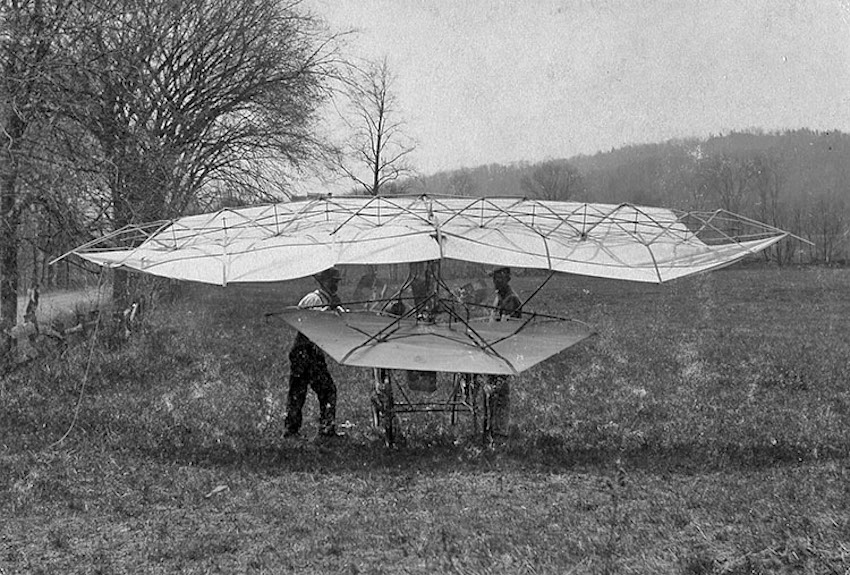
But the star of his inventions was one of the earliest aircraft prototypes, what he called a collapsible monoplane, or the Ochoa Plane — a glider with folding wings that he mounted on two bicycle frames. To develop his inventions, Ochoa founded the International Airship Company and the Ochoa Tool & Machine Company. 

On February 15, 1906, years after his release from prison, his friend U.S. President Theodore Roosevelt granted his application for a pardon and restored his American citizenship. Ochoa continued to monitor political developments in Mexico from New Jersey. One day, however, he suddenly disappeared, leaving behind his inventions. 


He had returned to El Paso to continue his political activities, combining them with journalism; he founded two newspapers, El Hispano-Americano and El Correo del Bravo. Documents from the archives at the National Museum of American History at the Smithsonian show that Ochoa was incarcerated again at the United States Penitentiary in Leavenworth, Kansas, on February 18, 1917, and released on May 1, 1918. 

While in Leavenworth, Ochoa continued to market his inventions, even writing the Navy to suggest that they use his Ornithopter as a prototype for designing airplanes.

Ochoa was also a miner, acquiring two gold mines in Sonora. He went into a business partnership on the mines with two men who offered to help him enlarge his gold mine production. They later double-crossed him, stealing all his gold and horses and leaving him to die in the desert. 

According to interviews given by his son Stephen Ochoa, in 1936, his father was walking down the street in El Paso with the police chief when he saw his two former business partners coming toward him; they drew their guns. Ochoa was unarmed but grabbed the chief’s gun and killed them both. 

Two men holding a prototype aircraft with a bicycle frame, another of Ochoa’s inventions. (Smithsonian)

Ochoa was once again brought before a judge, who determined that the shootings were justified but told Ochoa that given that the two dead men were from influential families, it might be best if Ochoa returned to Mexico. Ochoa took the judge’s advice and moved to Sonora in 1936.

Between 1901 and 1922, Ochoa was a prodigious inventor, even while leading an uprising, evading the law and being incarcerated. In addition to his patents in the United States and Mexico, he received patents in nine other countries.

This remarkable man is believed to have died in 1945 in Sonora with his wife Amanda Cole — granddaughter of painter Thomas Cole, founder of the Hudson River School for artists — at his side.

Sheryl Losser is a former public relations executive and professional researcher. She spent 45 years in national politics in the United States. She moved to Mazatlán in 2021 and works part-time doing freelance research and writing.